Here's a frustrating truth about studying: the technique that feels the most productive — long, intense cramming sessions the night before — is one of the least effective ways to build lasting memory. The technique that feels almost lazy by comparison, spreading small reviews across days and weeks, is one of the most powerful. Cognitive scientists call it the spacing effect, and it may be the single highest-leverage change you can make to how you learn.
The Key Takeaway
Spacing turns studying from a frantic sprint into a sustainable rhythm. You trade the false comfort of cramming for the real, durable confidence of knowing the material still lives in your head a month later. Start small: pick one subject, break your reviews into short sessions across the week, and let the gaps do the work. Your future self — the one sitting down at the exam — will thank you.
Where the idea comes from
In the 1880s, the German psychologist Hermann Ebbinghaus ran a punishing experiment on himself: he memorized long lists of nonsense syllables and tracked how quickly he forgot them. The result was the famous forgetting curve — memory decays rapidly at first, then levels off. But Ebbinghaus noticed something hopeful. Each time he relearned a list, the forgetting slowed. Reviews spaced out over time flattened the curve far more than the same amount of study crammed together.
More than a century of research has confirmed and extended his finding. When you revisit material just as you're beginning to forget it, you force your brain to work harder to retrieve it — and that effort is exactly what strengthens the memory. Reviews packed back-to-back skip this struggle, so they build weaker traces.
Why spacing beats cramming
Two mechanisms are doing the heavy lifting:
- Effortful retrieval. A review that happens after some forgetting has set in requires real mental work. That difficulty is desirable — it signals to your brain that this information matters and should be consolidated.
- Contextual variety. Studying on different days, in different moods and settings, attaches more retrieval cues to the memory. More cues means more paths back to the information when you need it.
The practical payoff is efficiency. Study after study finds that learners who space their practice remember substantially more weeks later than those who massed the same total minutes into one sitting — for less total effort, because you stop re-studying things you already know.
How to build a spaced schedule
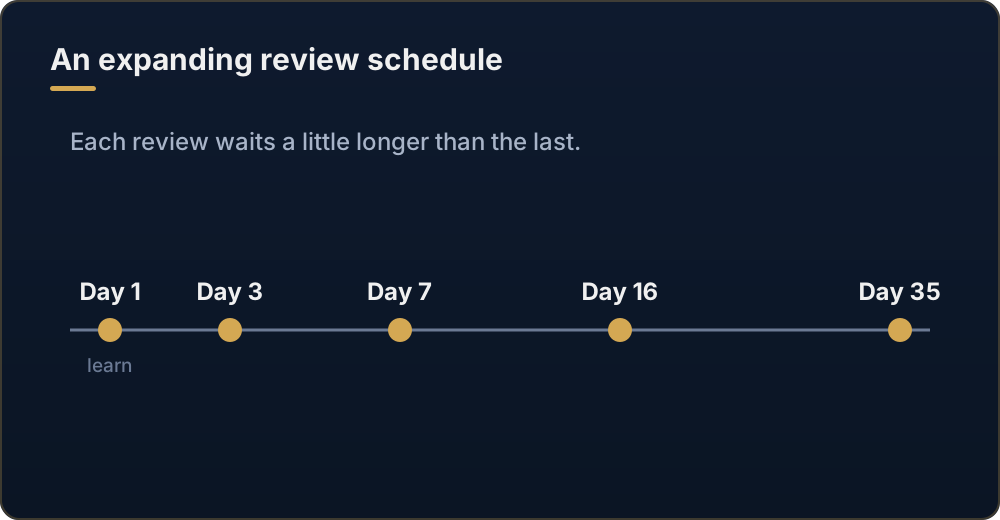
You do not need special software to start, though it helps. The core idea is to expand the gap between reviews each time you succeed:
- Review new material within a day of first learning it.
- Review again after two to three days.
- Then after about a week.
- Then after two to three weeks.
- Then monthly, until it feels automatic.
If you get something wrong, shorten the interval and build back up. If you nail it easily, stretch the gap. The schedule should always keep you at the edge of forgetting — that's the sweet spot where each review does the most work.
A simple starting system
Try the humble index-card box, organized into dated sections. Cards you know well graduate to sections you review less often; cards you miss drop back to the daily pile. This is the analog ancestor of every modern flashcard app, and it works because it automates the expanding-interval logic for you.
Digital tools take it further by scheduling each individual card based on how you rated your recall. That's the engine behind our own study apps — WordHype and HistoryHype quietly resurface the facts you're about to forget, so your review time lands where it counts instead of on material you already own.
Common mistakes to avoid
- Reviewing too soon. If the answer is still fresh, retrieval is too easy to build strength. Let a little forgetting happen.
- Rereading instead of retrieving. Spacing works best when each review is an active recall attempt, not a passive skim. Cover the answer and try to produce it first.
- Front-loading everything. Ten minutes a day for two weeks beats a single three-hour marathon — even though the marathon feels more impressive.