
Ask most students how they study and you'll hear the same answers: reread the chapter, review the notes, highlight the important parts. These feel like learning. They're comfortable, they're low-effort, and they produce a reassuring sense of familiarity. Unfortunately, that feeling is mostly an illusion — and decades of research explain why.
The Key Takeaway
The most effective study move is also the least comfortable: close the book and try to remember. Every retrieval is a rep for your memory. Build your sessions around producing answers rather than reviewing them, space those attempts across days, and you'll replace the false confidence of familiarity with the real thing — knowledge you can summon when it counts.
The testing effect
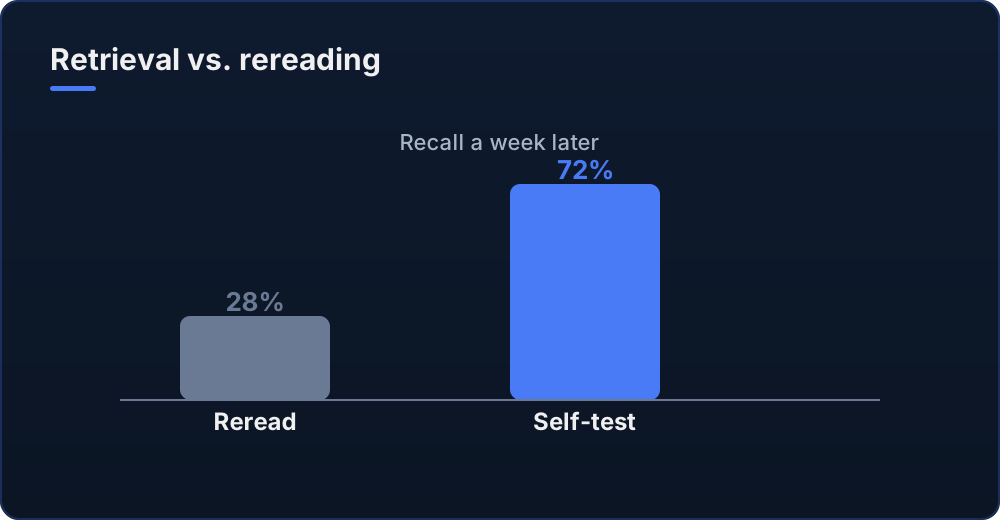
In a now-classic set of experiments, psychologists Henry Roediger and Jeffrey Karpicke had students learn passages and then either restudy them or take a practice test with no feedback. On a final test a week later, the students who had tested themselves dramatically outperformed those who had simply reread — even though the rereaders felt more confident. This is the testing effect, sometimes called retrieval practice: the act of pulling information out of memory strengthens it far more than putting it back in.
The intuition is worth sitting with. Every time you successfully retrieve a fact, you're not just checking whether you know it — you're physically reinforcing the neural pathway that leads to it. Rereading, by contrast, mostly increases fluency: the words start to look familiar, so you assume you've learned them. Familiarity and recall are not the same thing, and exams test the second one.
Why it feels wrong
Active recall is harder than rereading, and that's precisely the point. Cognitive scientists call these desirable difficulties — conditions that slow down learning in the moment but make it stick far better over time. The discomfort of straining to remember is the feeling of learning actually happening. If studying feels effortless, you're probably not building much.
This is also why so many students misjudge their own readiness. Rereading inflates confidence without building durable memory, so people walk into exams feeling prepared and then blank on questions they were sure they knew. Retrieval practice keeps your confidence honest: if you can't recall it during practice, you've found a gap while there's still time to fix it.
How to practice active recall
You can convert almost any study session into retrieval practice with a few simple habits:
- Close the book and brain-dump. After reading a section, put it away and write down everything you remember. Then check what you missed. The gaps are your study list.
- Turn notes into questions. Instead of rereading a definition, ask yourself the question it answers and try to produce the answer from memory.
- Use flashcards the right way. Always attempt the answer before flipping. A card you flip without trying is just rereading in disguise.
- Teach it. Explaining a concept aloud, as if to someone who's never heard it, is retrieval under pressure — and it exposes exactly where your understanding is fuzzy.
Combine it with spacing
Retrieval practice becomes even more powerful when you spread it out over time. Testing yourself on Monday, then again Thursday, then the following week, layers the benefits of the testing effect on top of the spacing effect. The two techniques are the backbone of nearly every evidence-based study method — and the reason well-designed flashcard tools schedule your reviews instead of dumping every card on you at once.
What to stop doing
- Highlighting on autopilot. Marking text is passive and, on its own, one of the weakest study techniques measured. If you highlight, do it sparingly and turn each highlight into a question later.
- Recopying notes. Transcribing feels productive but is closer to typing practice than learning. Summarize from memory instead.
- Judging readiness by familiarity. If your only evidence that you know the material is that it looks familiar, test yourself before you trust it.