
For decades, the ritual of test prep meant one thing: a thick stack of vocabulary flashcards and a lot of grim repetition. It's slow, it's miserable, and worst of all it doesn't work very well — most words memorized by brute force evaporate within days. Modern standardized tests lean less on obscure words than they used to, but a strong vocabulary still pays off across reading, writing, and essay sections. The trick is learning words the way your brain actually retains them.
The Key Takeaway
You don't beat the vocabulary sections by memorizing more words faster — you beat them by learning fewer words better. Context gives each word something to hold onto, imagery makes it vivid, and spacing makes it permanent. Trade the joyless flashcard grind for a system your brain is actually built for, and the words will still be there on test day — and long after.
Why rote memorization fails
Drilling a word and its dictionary definition treats vocabulary like a list of arbitrary pairs. But your brain doesn't store language as isolated pairs — it stores meaning in a web of context, associations, and usage. A word learned in isolation has almost nothing to hook onto, so it slides right back out. A word learned in context, connected to images and sentences and other words, has dozens of anchors. Give it those anchors and retention improves dramatically.
Learn words in context, not in isolation
The single biggest upgrade you can make is to stop memorizing definitions and start collecting words in their natural habitat:
- Pull words from real reading. When you meet an unfamiliar word in an article or novel, capture it with the sentence you found it in. That sentence is a ready-made memory cue.
- Write your own sentence. Using a word yourself — accurately — forces you to understand its shades of meaning, not just a synonym. This is retrieval practice applied to language.
- Group by theme or root. Words that share a Latin or Greek root cluster naturally. Learn that bene- means good and benevolent, benefactor, and benign reinforce one another.
Use imagery and the keyword method
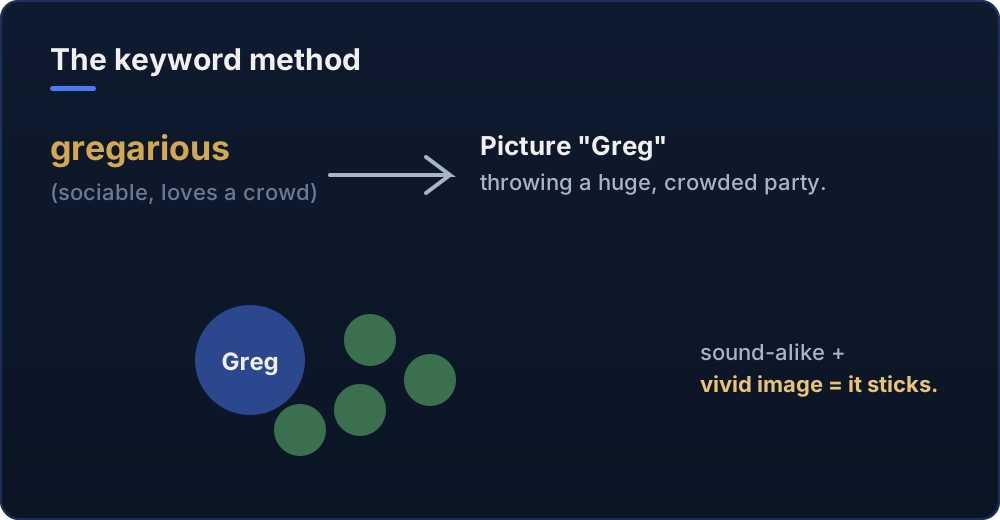
One of the best-studied vocabulary techniques is the keyword method: link a new word to a familiar word that sounds like it, then picture the two together. To remember that gregarious means sociable, imagine a man named Greg throwing a huge, crowded party. The absurd mental image is what makes the meaning stick — the same imagery principle behind the method of loci and behind why humor makes facts memorable.
This is exactly the engine inside WordHype, our vocabulary app: instead of dry definitions, it pairs each word with a vivid, often funny visual association, because a word you can see beats a word you merely read.
Space your reviews
However you learn a word, you'll forget it unless you revisit it on a schedule. Rather than reviewing your whole list every day — which wastes time on words you already own — use spaced repetition: see each word again just as you're about to forget it, stretching the interval every time you recall it correctly. A word you nail three reviews running has effectively moved into long-term memory, and you can nearly retire it. A word you keep missing comes back around sooner. This is why a smart flashcard schedule outperforms a static stack: your effort concentrates on the words that still need it.
A practical weekly routine
- Collect: add five to ten new words a week from your actual reading, each with its source sentence.
- Encode: for each word, write your own sentence and invent a quick keyword image.
- Review: do a short daily spaced-repetition session — a few minutes is plenty when the schedule is doing the sorting.
- Apply: try to use a new word in your writing or conversation within the week. Use cements memory better than any drill.