
Every year at memory championships, competitors memorize the order of a shuffled deck of cards in under a minute, or hundreds of random words in a few. They aren't born with photographic memories. Almost all of them use the same ancient technique — the method of loci, better known as the memory palace. The good news for the rest of us: it's learnable, and it's genuinely useful for studying.
The Key Takeaway
The memory palace isn't a party trick reserved for champions — it's a 2,500-year-old technique that turns your brain's natural strength for places into a tool for remembering almost anything. Build one small palace this week with a list you actually need to learn. Once you feel a set of facts snap into place along a familiar walk, you'll never look at memorization the same way again.
A trick older than the printing press
Legend traces the method to the Greek poet Simonides of Ceos, around 500 BCE. After a banquet hall collapsed, he reportedly identified the crushed victims by remembering exactly where each guest had been sitting. The insight he drew from it powers the technique to this day: human memory for places and spaces is extraordinarily strong. You can walk through your childhood home in your mind and describe every room. The method of loci hijacks that spatial memory to store anything you want.
Why it works
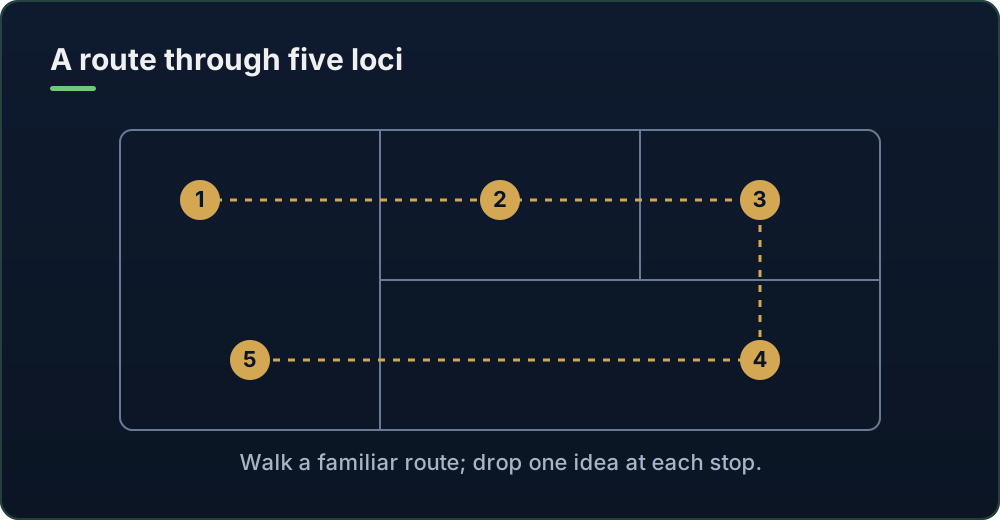
Your brain did not evolve to memorize vocabulary lists or historical dates. It evolved to navigate physical environments and remember where things are — where food was, where danger lurked, how to get home. That spatial-visual memory system is powerful and durable. The method of loci works by translating abstract information into vivid images and placing them along a familiar route, so recalling facts becomes as easy as taking a walk you already know.
How to build your first memory palace
Here's the whole method in five steps:
- 1. Choose a familiar place. Your home, your commute, your school hallway — anywhere you can picture clearly. Familiarity matters more than grandeur.
- 2. Define a route. Fix a consistent path through it: front door, entryway, kitchen counter, sofa, and so on. Always travel it in the same order.
- 3. Turn each item into an image. Abstract facts don't stick; vivid pictures do. To remember that the mitochondria is the powerhouse of the cell, imagine a tiny power station humming inside a cell. The stranger and more sensory the image, the better.
- 4. Place each image along the route. Mentally set the power station on your kitchen counter, the next fact on the sofa, and so on. Interact with each one — see it, exaggerate it, make it move.
- 5. Walk the route to recall. When you need the information, take the mental stroll. Each location hands back the image you left there.
Making images that stick
The quality of your images is what separates a palace that works from one that fades. A few principles memory athletes swear by:
- Exaggerate. Make things enormous, tiny, or absurdly out of place. Ordinary images blur together; ridiculous ones stand out.
- Add motion and emotion. A scene that's funny, gross, or dramatic is far stickier than a static one. This is the same reason humor makes facts memorable — emotional arousal tags a memory as important.
- Engage the senses. Give images a sound, a smell, a texture. More sensory hooks mean more paths back.
What it's good for — and what it isn't
The method of loci shines for ordered lists, sequences, and discrete facts: the bones of the hand, the presidents in order, the steps of a process, key dates. It's less suited to deep conceptual understanding — you still need to grasp why things work, not just recall that they do. Think of it as a powerful tool in a larger kit, best paired with retrieval practice and spaced review.
The underlying principle — turning dry facts into vivid, memorable images — is exactly what drives our education apps. HistoryHype and WordHype lean on the same brain science, wrapping facts in humor and imagery so they stick without you having to build a palace by hand.