Think about how you remember the water cycle. Odds are it's not a paragraph of text in your head — it's a picture: a sun, an ocean, arrows of evaporation rising into clouds, rain falling back down. That's dual coding at work. According to a well-established theory in cognitive psychology, your mind processes verbal and visual information through two distinct channels, and combining them creates richer, more retrievable memories than words alone.
The Key Takeaway
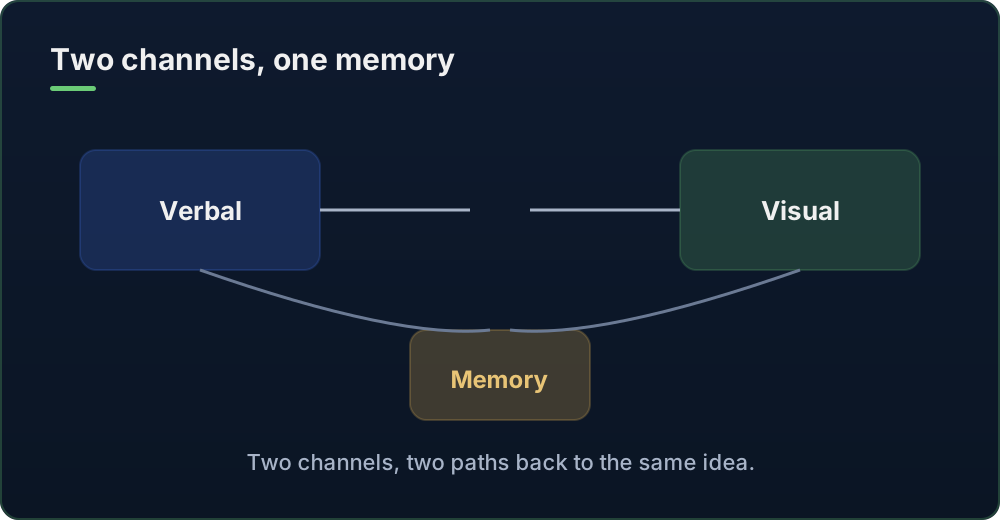
Words tell, pictures show, and your memory wants both. Whenever you're studying something abstract, ask how you could draw it, diagram it, or picture it — then pair that image with a clear verbal explanation. Two channels, two paths back, one much stronger memory.
The theory in brief
Psychologist Allan Paivio proposed dual coding theory to explain a simple observation: information paired with imagery is remembered better than information presented as words only. The idea is that a concept encoded both verbally (as language) and visually (as a mental image) gets two separate representations in memory — and two routes back to it. If one path fails at recall time, the other may still deliver. Two hooks are better than one.
Why combining channels works
Beyond simply doubling your retrieval paths, dual coding helps because the two channels don't compete for the same mental resources. Trying to hold six sentences in mind at once overloads your verbal working memory; pairing ideas with visuals spreads the load across systems that can work in parallel. A good diagram can carry relationships — hierarchy, sequence, cause and effect — that would take paragraphs to spell out, and carry them in a form your brain grabs almost instantly.
How to use dual coding when you study
- Draw what you're learning. Turn a process into a flowchart, a comparison into a table, a structure into a labeled sketch. The drawing doesn't need to be good — the act of translating words into a visual forces you to understand the relationships.
- Annotate diagrams in your own words. Take a textbook figure and explain each part in your own language. You're linking the visual and verbal channels deliberately.
- Build timelines and maps. For history, lay events on a timeline; for anything geographic, use a map. Spatial arrangement gives abstract facts a visual home.
- Invent vivid mental images. Attach a memorable picture to a concept or vocabulary word. This is the same principle behind mnemonics and the memory palace — and it's why an image sticks when a definition slides away.
A myth to leave behind
Dual coding is often confused with the popular idea of visual learners versus verbal learners — the notion that each person has a fixed style and should stick to it. Research has repeatedly failed to support that idea. The point of dual coding isn't that some people should use pictures instead of words; it's that everyone benefits from using pictures together with words. Don't pick a channel — combine them.
Where it fits with our apps
Pairing words with images is a core reason our education apps work the way they do. WordHype attaches a vivid visual association to each vocabulary word rather than a plain definition, and HistoryHype wraps facts in imagery and humor so they encode through both channels at once. It's dual coding, built in — so the learning does more per minute.